
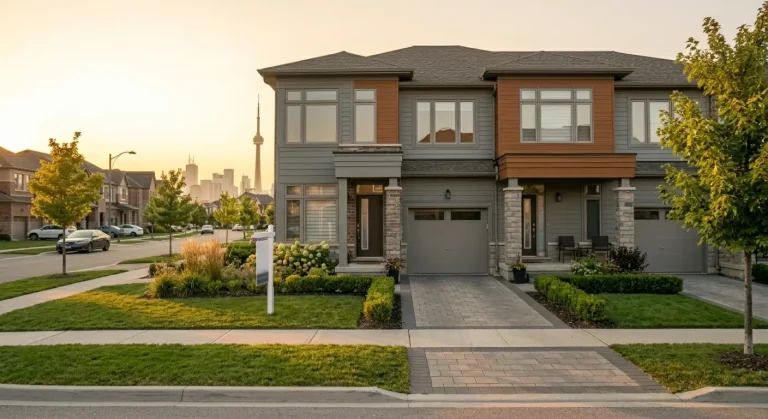
20% Down — The Non-Negotiable for Ontario Investment Properties
All non-owner-occupied rental properties require a minimum 20% down payment at any federally regulated lender in Ontario. No exceptions. CMHC does not insure pure rental properties — the insured mortgage pathway that lets owner-occupants put down 5%–10% simply does not exist for investment purchases.
This is the first thing that separates investment property financing from residential. A $700,000 single-family rental in Brampton requires $140,000 minimum down payment. The same property purchased as a principal residence could close with $55,000. That gap is real and it’s why equity accumulation — or a well-structured use of existing equity via HELOC or refinance — is the starting point for most Ontario investors.
Where lenders diverge on the 20%:
Most major banks and monolines accept 20% on a single investment property — but many internally require 25%–30% on your second, third, or fourth financed property. This is a policy choice, not a regulatory requirement. It varies significantly by lender and by your overall debt profile. I know which lenders apply 20% consistently across multiple properties and which ones tighten at the second door — that knowledge saves clients the $50,000–$70,000 difference between a 20% and 25% down payment requirement on a $700,000 purchase.
The house-hack exception:
If you purchase a 2–4 unit property and occupy one unit as your principal residence, the entire property qualifies for owner-occupied financing — as low as 5% down with CMHC insurance. This is one of the most powerful wealth-building strategies available to Ontario buyers and is widely underutilized. A Toronto or GTA buyer who purchases a duplex, lives in one unit, and rents the other is simultaneously building equity on a leveraged asset and offsetting their housing cost — with 5% down.
Rental Offset vs. Add-Back — How Lenders Count Your Income
This is where most Ontario investors hit walls they don’t understand. The method your lender uses to count rental income determines how much more you can borrow — and different lenders use different methods. Knowing which method a lender uses before you submit an application is one of the most valuable things a mortgage agent does for investor clients.
Method 1: The Offset Method (most common at A-lenders)
The offset method subtracts a portion of the rental income from the property’s carrying costs before calculating your GDS/TDS ratios. Most A-lenders use a 50% offset — meaning 50% of gross monthly rent is credited against the property’s expenses.
Example: A rental property with $2,400/month rent. Under 50% offset, $1,200/month is applied against the property’s mortgage, tax, and insurance costs. If those carrying costs are $2,800/month, the net TDS impact is $1,600/month instead of $2,800/month. This significantly improves your qualifying ratios.
Method 2: The Add-Back Method
Under this method, 100% of rental income is added to your personal income, and 100% of the rental property’s expenses are added to your debts. The math is less favorable for most investors — particularly on properties that don’t generate strong positive cash flow after all costs.
Method 3: Full Rental Income Offset (some B-lenders and credit unions)
Some B-lenders and provincial credit unions will credit 80%–100% of rental income directly against the property’s carrying costs. On a well-cash-flowing property, this can mean the rental unit adds zero net TDS impact — it effectively qualifies itself. Rates carry a modest premium but the qualifying benefit is material.
Method 4: DSCR Programs (next section)
DSCR programs bypass personal income qualification entirely — the property’s own cash flow is the qualifying metric. See Section 3.
The method your file gets underwritten under can change your maximum qualifying amount by $150,000–$250,000. I model all available options for your specific portfolio before recommending which lender to target.
DSCR Lenders — When the Property Qualifies Itself
Debt Service Coverage Ratio (DSCR) lending is the pathway Ontario investors turn to when traditional income qualification becomes the limiting factor — typically from the 3rd or 4th property onward when TDS ratios start tightening.
How DSCR qualification works:
Instead of evaluating your personal income and debts, the lender evaluates the property’s own cash flow. The formula:
DSCR = Gross Rental Income ÷ Total Annual Debt Service (mortgage P+I + property tax + insurance)
Most DSCR lenders in Ontario require a minimum ratio of 1.10–1.25. This means the property’s gross rent must cover 110%–125% of its total carrying costs.
Example: A rental property in Hamilton with $2,200/month rent. Annual rent: $26,400. Annual debt service (mortgage + tax + insurance): $22,800. DSCR: $26,400 ÷ $22,800 = 1.16 — this clears most DSCR lender requirements.
Who DSCR lending is for:
DSCR programs are most useful for Ontario investors who have strong rental income but complex personal income documentation (self-employed, high existing debt from multiple properties, or variable income). The property qualifies on its own merits — your T4 or NOA becomes a secondary consideration.
Rate premium: DSCR programs typically carry a rate premium of 50–100 basis points above standard A-lender rates for investment properties. At 2026 A-lender investment rates of approximately 5.10%–5.40%, a DSCR mortgage runs approximately 5.60%–6.00%. The premium is the cost of the underwriting flexibility — for most investors scaling past their 3rd door, it’s worth it.
GTA market reality check: In 2026, single-family detached rentals across most of the GTA do not generate positive DSCR at current prices and rates. A $900,000 Toronto semi-detached renting for $3,200/month against a $4,200/month carrying cost DSCR is 0.76 — well below threshold. DSCR lending works better in secondary Ontario markets: Hamilton, Oshawa, Kitchener-Waterloo, London, Windsor, and St. Catharines — where rent-to-price ratios still support positive DSCR.
Portfolio Financing — What Happens After Your 4th Property in Ontario
This is the section most mortgage guides don’t cover — because most mortgage agents don’t have active relationships in this space. Here’s what actually happens as your Ontario rental portfolio grows.
Properties 1–4: Standard residential territory
Most A-lenders — major banks, monolines, federal credit unions — will finance up to 4 properties for a single borrower using standard residential mortgage products. Rates are competitive. Application process is familiar. Rental income treatment follows standard offset or add-back methods.
Properties 5–6: The transition zone
At 5–6 financed properties, you’ll notice a significant reduction in A-lender options. Several major bank and monoline programs have internal caps at 4–5 properties. You start seeing higher documentation requirements: 2-year rental history on all existing properties, detailed property schedules, sometimes full financial statements if self-employed. Rate premiums of 25–50 basis points start appearing.
This is the stage where working with a broker becomes especially important — not every lender accepts 5-property files, and the ones who do have specific requirements that aren’t publicly advertised.
Properties 7+: Portfolio lender territory
Standard residential lenders largely exit the picture above 6–7 financed properties. Your primary options at this scale:
Portfolio lenders: Institutional lenders that specialize in multi-property rental portfolios. They evaluate the portfolio as a whole rather than individual properties. Rates run 50–150 basis points above standard A-lender rates. Minimum portfolio values typically $1M–$2M.
Commercial mortgages: For portfolios with 5+ residential units or mixed-use properties. Commercial underwriting based on NOI and cap rates rather than personal income. Terms typically 1–5 years with balloon payments.
Provincial credit unions: Not subject to federal OSFI regulations. Some Ontario credit unions actively seek portfolio investors and have developed specific programs for 5+ property files. Rates competitive with A-lenders on well-structured files.
Private lenders: Short-term bridge financing for acquisitions while portfolio repositioning happens. Rates significantly higher (8%–12%+) — used strategically, not as a long-term solution.
I have active relationships with portfolio lenders in all of these categories and submit investor files across all portfolio sizes regularly.
Ontario Landlord Rules — What Affects Your Investment Math
Understanding Ontario’s residential tenancy framework isn’t just legal housekeeping — it directly affects your proforma, your cash flow projections, and which lenders will consider your application.
Rent control and annual increases:
Ontario’s Rent Increase Guideline caps annual rent increases for existing tenants at a provincially set percentage. For 2026: 2.5%. This cap applies to all rental units first occupied before November 15, 2018. Units first occupied after that date are exempt from rent control — landlords can set rent at market upon tenant turnover.
For investment analysis: model rent increases at the guideline rate on occupied units and at market rate on vacancies. The difference between the two can be $300–$600/month on a long-tenanted unit in Toronto or Vaughan — a meaningful gap that affects both cash flow and property value.
Landlord and Tenant Board (LTB) timelines:
The Landlord and Tenant Board processes eviction applications on non-payment of rent, but timelines in Ontario have been notoriously long — 6–18 months in contested cases in Toronto and the GTA. For investment underwriting purposes, model a 3-month vacancy buffer as minimum for any property where tenant turnover is possible. Some lenders factor this into their rental income discount — using 85%–90% of gross rent rather than 100% in their calculations.
Short-term rentals (Airbnb, VRBO):
STR operation is restricted in Toronto (must be principal residence), Hamilton, Mississauga, and most major Ontario municipalities. Lenders will not count projected Airbnb revenue as qualifying rental income. If a purchase is contingent on STR income to service the mortgage — verify municipal zoning and licensing requirements before proceeding.
Ontario non-resident speculation tax:
Non-Canadian buyers pay a 25% Non-Resident Speculation Tax (NRST) on top of standard LTT on residential properties in most Ontario markets. Exemptions apply for permanent residents and certain work permit holders. If applicable to your situation, this must be factored into your acquisition cost and cash-on-cash return calculation.
BRRRR Strategy in Ontario — How It Works and Which Lenders Support It
Buy-Renovate-Rent-Refinance-Repeat (BRRRR) is an equity recycling strategy that allows Ontario investors to redeploy capital across multiple acquisitions without requiring new down payment funds for each property. It works — when the numbers are right and you’re working with lenders that understand it.
The BRRRR sequence in Ontario:
Buy: Acquire a distressed or undervalued property using conventional purchase financing (20% down). Target properties where the after-repair value significantly exceeds the purchase price plus renovation cost.
Renovate: Improve the property to increase both rental income potential and market value. In Ontario markets, kitchen and bathroom renovations, basement suite additions, and structural improvements produce the strongest value increases.
Rent: Lease the property at market rates to establish rental income history. Most refinance lenders want to see a signed lease in place before completing an appraisal.
Refinance: Refinance based on the new, higher appraised value — typically targeting 75%–80% LTV. If the after-repair value is high enough, the refinance proceeds can fully or partially return your original down payment and renovation capital.
Repeat: Deploy the returned capital into the next acquisition.
The Ontario BRRRR reality:
The BRRRR strategy depends entirely on the gap between purchase price + renovation cost and after-repair value. In high-price GTA markets — Toronto, Vaughan, Mississauga, Markham — this spread is difficult to achieve because prices are already near market value. BRRRR works more consistently in Ontario markets where distressed or undervalued properties are more available: Hamilton, Oshawa, Niagara Region, Brantford, Sudbury, and similar secondary markets.
Which lenders support BRRRR in Ontario:
Not all lenders will refinance based on after-repair value. Approximately 6–8 lenders in Ontario have programs that refinance on ARV with proper documentation: independent appraisal, signed lease, proof of renovation completion, before-and-after photos. I work with these lenders specifically when structuring BRRRR files. The standard institutional lender that refinances on purchase price plus documented improvements is a different product — confirm your lender’s ARV policy before committing to the renovation spend.
Ontario Investment Property Cash Flow — Running the Real Numbers
Before any application, run your cash flow. Many Ontario investors focus on mortgage qualification without checking whether the property actually generates sustainable returns at current rates and prices. Here’s the framework:
The basic cash flow formula:
Gross Annual Rent
− Vacancy allowance (5%–10% of gross rent)
− Property management (8%–10% if not self-managed)
− Maintenance reserve (5%–8% of gross rent)
− Property tax (varies by municipality)
− Insurance ($150–$300/month typical)
− Mortgage interest (principal repayment is equity building, not expense)
= Net Operating Income (NOI)
NOI ÷ Purchase Price = Cap Rate (market benchmark for comparison)
NOI − Annual Mortgage Payment = Annual Cash Flow
2026 GTA market reality:
At current prices and rates, single-family detached rentals across most of Toronto and the inner 905 are generating neutral to slightly negative monthly cash flow at 20% down. This does not necessarily make them bad investments — appreciation and equity buildup are real returns — but it means the investment case is primarily capital growth rather than income.
Where positive cash flow still exists in Ontario (2026):
Multi-unit properties (duplex, triplex, fourplex) in the GTA — the additional units change the rent-to-price ratio meaningfully.
Secondary Ontario markets: Hamilton (cap rates 5%–6.5%), Oshawa, Kitchener-Waterloo, London, Windsor, St. Catharines, Sudbury — where rent-to-price ratios remain favorable.
Example — Hamilton Duplex:
Purchase price: $620,000 | Down payment (20%): $124,000
Combined rent: $3,800/month | Annual rent: $45,600
Vacancy (7%): −$3,192 | Management (8%): −$3,648 | Maintenance (6%): −$2,736 | Tax: −$6,500 | Insurance: −$2,400
NOI: $27,124 | Cap rate: 4.4%
Annual mortgage payment (4.79%, 25yr, $496,000): −$32,640
Annual cash flow: −$5,516 (−$460/month)
Modestly negative — but with rental income offsetting most carrying costs and equity building at approximately $12,000/year in principal repayment. At a 3% annual appreciation rate, the $620,000 property gains $18,600/year. Total annual return including equity and appreciation: approximately $25,100 on $124,000 invested = 20.2% annual return.
This is the correct way to evaluate Ontario investment properties in 2026 — not just monthly cash flow, but total return including equity.
I model these numbers for any specific property before you apply. It takes 30 minutes and it’s always worth doing before committing to a purchase.
Common Investment Property Mistakes Ontario Buyers Make
1. Underestimating true carrying costs.
Modeling mortgage + tax only and ignoring vacancy, maintenance, management, and insurance. A property that looks cash-flow positive at $3,200 rent versus $2,800 mortgage + tax is often cash-flow negative once all costs are included.
2. Going to your bank first.
Your personal bank evaluates investment files conservatively. They apply the most restrictive rental income treatment, often require 25%+ down on multiple properties, and don’t have access to DSCR programs. A broker with investment lender relationships produces meaningfully different outcomes on the same file.
3. Only comparing fixed-to-fixed.
Variable rate mortgages on investment properties carry the same penalty advantage as on principal residences — three months’ interest vs. potentially severe IRD on a fixed. For investors who may want to sell or refinance within the term, variable rate flexibility has real value.
4. Ignoring the stress test on subsequent properties.
The B-20 stress test applies to every investment mortgage at federally regulated lenders, regardless of how many properties you own. Your qualifying rate is always contract + 2% or 5.25% minimum. Planning your acquisition sequence with this in mind — maximizing rental income offset at each step — is part of a well-structured portfolio strategy.
5. Modelling Airbnb income without confirming zoning.
In Toronto, Hamilton, Mississauga, and most Ontario major municipalities, Airbnb operation is restricted to principal residences. Lenders will not count projected STR income regardless. Buying a property that pencils only on STR revenue is a significant risk in Ontario’s current regulatory environment.
6. Not planning the exit from BRRRR refinances.
Some investors complete a BRRRR renovation and then discover their target lender won’t refinance on after-repair value — or requires more documentation than expected. Confirm your refinance lender before committing renovation budget, not after.
Investment Mortgage Questions Answered
Ontario Investment Property — Frequently Asked Questions
Yes — but structure matters significantly. If you purchase a 2–4 unit property and occupy one unit as your principal residence, you qualify for owner-occupied financing with as little as 5% down through CMHC insurance. This “house-hack” strategy is one of the most efficient entry points into Ontario real estate investing. If you purchase a pure investment property as your first property — without occupying any unit — you need 20% down and investment mortgage qualification.
680+ for the best rates and maximum lender options on investment properties. 620–679 will qualify with most A-lenders at minor rate premiums. Below 620 pushes you into B-lender territory with rates 50–150 basis points above A. Note that investment property applications are underwritten more conservatively than owner-occupied files at most lenders — a strong credit score carries more weight on an investor application.
Depends on the lender. Most A-lenders use the 50% offset method — 50% of gross monthly rent is credited against the subject property’s carrying costs. Some B-lenders and credit unions use 80%–100% offset. DSCR programs bypass personal income qualification entirely and evaluate the property’s own cash flow. I model all available approaches before deciding which lender to target for your specific file.
In the GTA (Toronto, Vaughan, Mississauga, Markham, Brampton), achievable cap rates on single-family properties are approximately 3%–4.5%. Duplex and triplex properties improve this to 4%–6%. Secondary Ontario markets (Hamilton, Oshawa, Kitchener-Waterloo, London) offer 5%–7% cap rates on well-selected properties. Cap rate alone doesn’t determine a good investment — total return including appreciation and principal repayment provides the complete picture.
There is no regulatory limit — but lender policies are the practical constraint. Most A-lenders have internal caps at 4–6 financed properties. Above that threshold: portfolio lenders, commercial mortgages, and DSCR programs are the primary options. I have active relationships with lenders across all portfolio sizes and submit investor files from first rental through 10+ property portfolios. The strategy changes at each threshold — I’ll map your current portfolio to the right lender for each next acquisition.
Yes — this is a common and legitimate strategy. A HELOC on your principal residence provides access to equity at rates typically 6.95%–7.45% (Prime + 0.45%–0.95%) in 2026. The HELOC funds the investment property down payment, and the investment property generates rental income to service both mortgages. The HELOC payment does count in your TDS ratio, so the math needs to work across your full debt picture. I model the combined qualification impact before recommending this approach.
Yes — investment property mortgages carry a rate premium of approximately 20–50 basis points above equivalent owner-occupied rates at A-lenders. At 2026 owner-occupied 5-year fixed rates of 4.79%–4.89%, investment property rates run approximately 5.00%–5.40%. B-lender and DSCR programs carry higher premiums of 50–150 basis points above A. The rate premium reflects the higher default risk on investment properties, which don’t carry CMHC insurance protection.
Rental offset programs still qualify you based on your personal income — they just credit rental income against the property’s costs to improve your TDS ratio. Your T4, NOA, or business income is still the primary qualification metric. DSCR programs remove personal income from the equation entirely — the property qualifies based on its own cash flow (gross rent ÷ total carrying costs). DSCR is the pathway for investors whose personal income qualification has been exhausted by multiple properties.
Still Have Questions?
Not seeing your exact situation here? Let’s take a look at your numbers and walk through your options step by step.
Free Ontario Investment Property Calculators
Run Your Investment Numbers Before You Make an Offer
Three calculators for Ontario real estate investors — qualify your mortgage, check your debt ratios, and compare two investment scenarios side by side.

Affordability Calculator
Maximum Mortgage Calculator Ontario
Find out how much mortgage you can afford based on income, debts, and the B-20 stress test. See what lenders will actually approve in Ontario.

Lender Qualification Metrics
Debt Service Ratio Calculator Canada
Calculate your Gross Debt Service (GDS) and Total Debt Service (TDS) ratios — the key numbers lenders use to approve mortgages in Canada.


